The Integrated Fisheries Management Plan (IFMP) for Pacific herring in 2025/2026 has now been released, setting out where and how many herring may be harvested in B.C. this season. Earlier this year, Fisheries and Oceans Canada (DFO) invited public feedback on multiple harvest options in the draft plan.
In October, Pacific Wild submitted formal feedback calling for a coastwide closure of all commercial herring fisheries (excluding Indigenous Spawn-on-Kelp and Food, Social, and Ceremonial fisheries). We urged the federal government to listen to First Nations, coastal communities, and British Columbians calling for a precautionary, ecosystem-based approach to herring management.

This year, Pacific Wild stood alongside First Nations, allied conservation groups and community members at DFO’s office in Vancouver with one clear message:
Let the Herring Live.
Hereditary Chief Eric Pelkey of the Tsawout W̱SÁNEĆ Nation shared how herring were once central to W̱SÁNEĆ food, trade, and cultural identity—but in many areas, they haven’t spawned in 25 years.
Dr. David Suzuki called for an immediate, permanent ban on herring fishing in the Strait of Georgia, emphasizing that it’s outdated to think of all herring as part of a single breeding population. Because of philopatry, the tendency of herring to return to their local spawning grounds, the loss of spawning in one region cannot be replaced by fish from another. Overfishing a local population can result in irreversible collapse.
Despite clear science and community opposition, DFO has doubled down on the same harmful status quo. Kill fisheries continue. The department’s “talk and fish” approach carries on. And this year, DFO has increased the herring Total Allowable Catch (TAC) once again in the Strait of Georgia.

A Step Backward: Increased Catch in the Strait of Georgia
In a troubling move, DFO has raised the TAC in the Strait of Georgia (SOG) by 1,603 tons for the 2025/26 season.
2025/2026 quotas
STRAIT OF GEORGIA (SOG):
OPEN to FSC, Roe, Food & Bait, and Special Use fisheries at a 14% harvest rate, reaching a maximum of 14,390 tons. The Food & Bait fishery has been allocated 2,100 tons. For the Roe Fishery, seine vessels have been allocated 5,794 tons; gillnets 5,559 tons.

WEST COAST VANCOUVER ISLAND:
CLOSED to commercial gillnet and seine harvest. Open to FSC, Treaty Domestic Harvest and commercial Spawn-on-Kelp opportunities
CENTRAL COAST:
OPEN for a 4% harvest rate for commercial Spawn-on-Kelp only, to a maximum of 900 tons. All other commercial fisheries remain closed.
The Heiltsuk Nation has voted to keep its 2026 Spawn‑on‑Kelp herring fishery closed, choosing recovery over income and tradition to help struggling herring stocks rebuild rather than opening to commercial harvest.
PRINCE RUPERT DISTRICT (PRD):
OPEN at an 8% harvest rate for FSC, Spawn-on-Kelp and Roe herring fisheries, with a maximum TAC of 3,715 tons—a 1,091 ton increase from last year. Seine vessels are allocated 1,163 tons; gillnets 952 tons.
HAIDA GWAII:
Closed to commercial harvest.
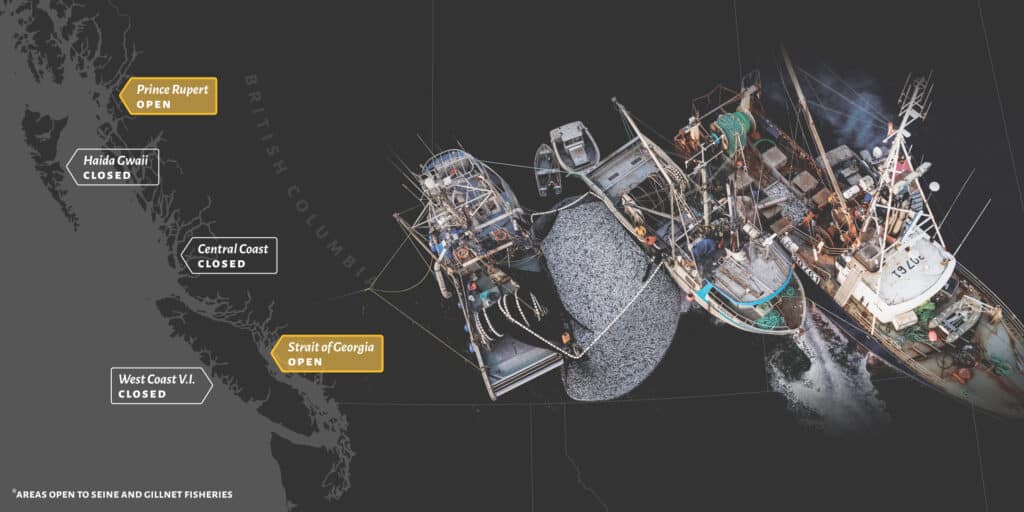
While we commend DFO for keeping Haida Gwaii, the West Coast of Vancouver Island, and the Central Coast closed to net-fisheries—aligning with requests from First Nations and independent scientists—the increase elsewhere undermines ecosystem recovery and public trust.
Pacific herring populations remain in a fragile state. These #BIGLittleFish deserve a full commercial moratorium (excluding FSC and SOK) until stocks have recovered enough to support predators, ecosystems, and the coastal communities that depend on their return.
What DFO Ignored: Marine Conservation Caucus Refuses Endorsement Again
For the second consecutive year, the Pacific Marine Conservation Caucus (MCC), which includes independent scientists from several B.C. conservation groups, has now declined to endorse any of DFO’s proposed herring harvest options in the Strait of Georgia. The MCC holds a seat as an official representative for the conservation sector on the Integrated Herring Harvest Planning Committee (IHHPC). The IHHPC is intended to provide a streamlined, representative, cross-sector advisory forum for herring harvest planning, management, and post-season review. Its mandate includes supporting coordinated fishing plans, identifying potential conflicts, and recommending pathways to resolve disputes. However, for the second consecutive year, advice from conservation representatives appear to have been sidelined in final management decisions.
This is significant. Why?
Because DFO is not incorporating science advice from independent researchers, especially on three critical fronts:
- Long-Term Loss of Herring Spawn Across the Strait of Georgia
While overall biomass appears “stable,” spawning distribution has collapsed across the Gulf Islands, Cape Lazo, and the eastern Strait of Georgia. Spawning has been lost from many areas, with no signs of recovery. In the southern Strait of Georgia, William Head to Saanich (Area 19) has not hosted significant spawning since before 1950. Spawning between Saanich to Mayne Island (Area 18) underwent a sudden, severe, and persistent collapse in the 1980s, and has not recovered. Now from Galiano Island to Nanoose Bay (Area 17), spawning events have declined to their lowest recorded level in recent years.
- Northward Shift in Spawning
Herring are increasingly spawning farther north, concentrating into a smaller geographic region—an ecological red flag that signals population stress, habitat shifts, and potential loss of sub-populations that remain unidentified and unaccounted for in DFO’s management strategy.
Loss of Elder Herring and Cultural Memory
Evidence shows older herring guide younger fish back to spawning grounds. Removing these “knowledge holders” can cause spawning traditions to permanently collapse.
An Undignified End for an Unparalleled Fish: Where Herring Harvested in the Salish Sea End Up
Of the 14,390 tons approved for harvest in the Salish Sea this year, nearly 80% (11, 353 tonnes) goes to the Roe fishery, which targets the female fish for just one purpose: their roe, for only about 12 % of their biomass. The roe is exported overseas, contributing nothing to Canadian food security. The remaining bodies of both females and males are largely ground into fish meal and oil, ending up in pet food, aquaculture feed, and fertilizer.
Another 2,100 tons are allocated to the Food & Bait fishery. While about 5% of the catch will be donated to charity, most ends up as bait or low-value products, with very little reaching Canadian plates. The Special Use fishery accounts for an additional 902 tonnes, primarily for bait and captive marine mammal feed.
In total, only an estimated 285 tonnes of Salish Sea herring are expected to be consumed directly by people, locally.
This is an undignified fate for a species that sustains an entire web of marine life, from salmon and seabirds to sea lions and whales, and underpins the health of B.C.’s coastal ecosystems.
Take Action for Pacific Herring
You can stand up for Pacific herring today:
- Send a letter voicing your opposition to the unsustainable commercial herring fishery in B.C..
- Share this story with your community and help amplify the call: Let the Herring Live.