The connection between wolves and dogs runs deep, stretching back thousands of years, shaping one of the most remarkable relationships between human and non-human animals. Understanding their shared history can reveal not only how dogs came to live alongside us, but also how we see, understand, and coexist with their wild relatives.
In August 2026, Pacific Wild hosted a webinar featuring canid research specialist Dr. Kathryn Lord and founder of Women For Wolves Anjali Ranadive. Together, we discussed the behavioural, genetic and cultural similarities and differences between these two incredible species.
Understanding the link between dogs and wolves requires looking beyond shared ancestry. Their story is also about ecological change, domestication, early development, social relationships, and the differing ways each species came to relate to humans.
Over time, human cultures came to embrace dogs as companions and family members, while often casting wolves as threats or enemies, particularly as agriculture expanded. This divergence reveals how profoundly human culture has shaped our relationships with two closely related species.
But how do two animals with such a close evolutionary relationship operate so distinctly in our modern world, and how can this knowledge inform wolf conservation?
Are Dogs Descended From Wolves?
Dogs (Canis familiaris) and grey wolves (Canis lupus) descended from a common ancestor, an ancient wolf species that no longer exists.

Evidence suggests that dogs emerged from two separate wolf populations — one in East Asia, and another in Western Eurasia — and eventually interbred and led to the modern domesticated dogs we know today.1
Dogs are the first known animal domesticated by humans; our close relationship with them extends back at least 15,000 years.
But how did this happen? There are several hypotheses about how and why dogs evolved from wolves, with varying levels of scientific support.
Pup-adoption Hypothesis:
The human-selection hypothesis (sometimes called the “pup-adoption” hypothesis) proposes that humans actively adopted wolf pups and selected those that were more docile to breed. Over generations, these increasingly docile wolves evolved into domesticated dogs. In this scenario, humans may have purposely domesticated wolves for one or more reasons, such as to help them hunt, to protect them from other predators, and to serve as companions.2
Self-domestication Hypothesis:
Dr. Lord’s research suggests that the self-domestication hypothesis (also known as the “proto-domestication” or “commensal scavenger” hypothesis) is a more likely one.3 It proposes that wolves slowly domesticated themselves when they began scavenging for human food and garbage, which gave them a survival advantage. As certain wolf packs habituated to human-occupied environments, they evolved to become less aggressive and more dependent on humans, losing much of their “wildness” in the process.
Both of these hypotheses raise many questions, and neither can definitely be proven. As Marshall-Pescini et al. put it, “only a time-machine would allow us to determine which scenario occurred, and quite possibly both processes played a role” in dog domestication.
In other words, dogs are wolves who rapidly evolved to thrive alongside humans.
What Is the Difference Between a Wolf and a Dog? Are Wolves and Dogs the Same Species?
Dr. Lord explains that dogs and wolves are genetically very similar. But how similar?
A study by Lindblad-Toh et al. found that dogs and grey wolves share over 99% of their DNA, highlighting just how closely related the two are.5
This genetic similarity between wolves and dogs explains why the two species are able to breed and produce fertile offspring – a trait that distinguishes them from most other animal hybrids (e.g. mules), which are unable to reproduce. That means that a wolf and a dog can mate and have puppies, and these wolf-dog hybrid offspring will also be able to mate and have viable pups of their own. Yet despite their heavily shared genetics, dogs and wolves have very different behaviours, survival strategies, and relationships with humans.
Put simply, dogs depend on us to survive, while wild wolves typically take great measures to avoid humans.
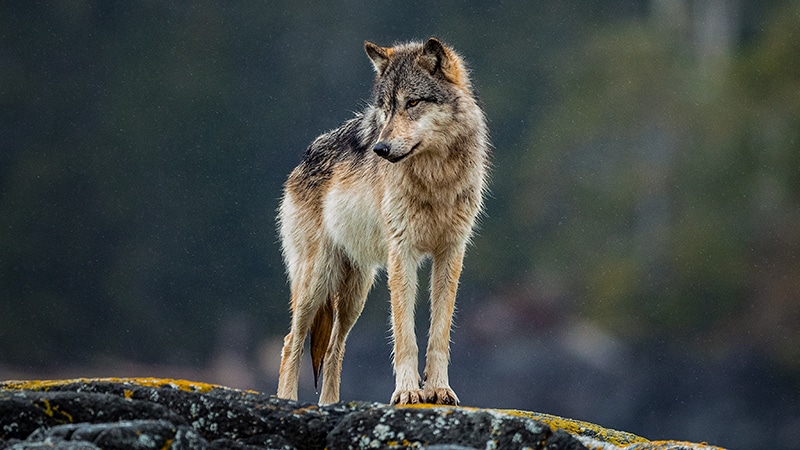
Wolf watching from atop a boulder. Photo by Ian McAllister.
wolves
Wolves are adapted to survive by hunting in packs. Given the danger and difficulty of hunting large prey (e.g. moose, whose weight can exceed that of an average wolf by more than tenfold), doing so in a group is advantageous. Even so, hunting success rates are often low, anywhere between 10% and 49%.6 The location and abundance of prey also varies seasonally. Depending on the size of the wolf pack and the density of prey, a pack’s territory can range from 50–1,000 km²; the lower the prey density, the larger range a pack needs to sustain themselves.
A wolf pack is a cohesive family group that typically consists of a breeding pair and their offspring, including pups and adults. Sometimes unrelated wolves may join the pack. A typical pack ranges from four to nine members, but can vary widely depending on territory size, availability of prey, and geographic region. The breeding pair form a long-term bond but all members of the pack participate in pup rearing, including helping feed the pups by regurgitating food, and protecting them from other predators.
Wolf packs divide the labour, working as a group to hunt, defend their territories and rear the pups. While there is often hierarchy (usually based on age) within the pack, the concept of the “alpha wolf” or “alpha male” is a fallacy.7 Researchers describe the dynamic of a wolf pack as a network of cooperating individuals, where dominant and subordinate animals rely on an ongoing exchange of mutual support rather than a simple chain of command.8 Moreover, a cohesive and functional pack structure is beneficial to each wolf’s survival.
As a highly social, pack-living species, wolves form complex social relationships and maintain strong bonds with members of their pack. Beyond cooperative hunting, pup rearing, and territorial defence, wolves engage in a range of social behaviours that reinforce pack cohesion, including resting in close proximity, grooming one another, and participating in play behaviours such as wrestling and chasing. While some wolves may forage or travel alone, this is often a transitory phase in which a mature wolf is in the process of dispersing to find a mate and start a new pack.9
In contrast, wolves have historically had a far more adversarial relationship with humans. Their tendency to avoid people is partly shaped by generations of persecution, while competition for shared prey and habitat space – particularly following the expansion of agriculture and livestock production – further contributed to human-wolf conflict and the perception of wolves as competitors and threats.10
While it is true that wolf pups raised by humans will form attachments to their human caregivers, these studies placed the pups in a very controlled environment, isolated from other wolves with their only social exposure being humans. Notably, wolf pups were able to socially learn from humans to the same ability as dogs. However, dogs require significantly less exposure to humans to form attachments.11 And as Dr. Lord explained in Pacific Wild’s webinar on wolf and dog evolution, wolf pups who bond with their caregivers still display fear and avoidance in the presence of other humans.

Dogs on a stroll for Pacific Wild’s Dog Walk for Wolves event. Photo by Roan Bohonos.
dogs
Contrary to common knowledge, 70–80% of the world’s dogs are free-ranging rather than the “pet dog” that many of us care for.12 Free-ranging dogs are self-sustaining populations of “free-breeding” animals, meaning they independently choose their mates.13 Many free-ranging dogs descend from ancestors native to the given region.
Free-ranging dogs (colloquially called “street dogs”) are commonly found in regions such as South and East Asia, Eastern Europe, and South America. They typically live near human settlements, and their diet consists mostly of human waste. Some dogs even evolved the capacity to better digest starches from grain, including an increased number of copies of the AMY2B gene compared to their wolf relatives, which assists with starch digestion.14 Additionally, some dogs developed an increased resistance to human microbes. Scavenging rather than hunting is their feeding strategy and is usually a solitary activity. They will typically only hunt if human food sources are insufficient.
Wolves aren’t the only wild canids sharing habitat with free-ranging dogs. Coyotes (Canis latrans) are built more like solitary specialists than pack hunters: the bulk of their diet is small, easily caught prey such as rodents and rabbits, and true cooperative pack hunting is reserved for the rare occasions when coyotes go after prey larger than themselves.15 Red foxes (Vulpes vulpes) take this even further; they hunt small mammals and birds essentially alone year-round, without the need for cooperative hunting.16 They’ll also readily scavenge carrion, including leftovers from wolf kills, whenever the opportunity arises.17
On the cooperation spectrum, coyotes and foxes sit closer to free-ranging dogs than to wolves: like dogs, their default strategy is solitary and opportunistic, built around prey (or carrion or garbage) that doesn’t demand teamwork to exploit. Wolves remain the outlier among these canids, dependent on sustained group cooperation because the animals they hunt are often too large and dangerous for one wolf to reliably bring down alone (although it is interesting to note that some populations, like the coastal wolves in B.C., also forage for invertebrates, fish, and small marine mammals).
Because dogs do not hunt as a group like wolves, they don’t need to maintain friendly or peaceful relationships with other dogs, making them less social with each other. However, they do have the propensity to form strong, fast attachments to humans, and these bonds can develop with only minimal exposure. Studies comparing hand-raised wolf pups and dog puppies have found that dogs actively seek out human eye contact and use it to gather information, a behaviour that wild-living dogs and wolves rarely display outside of intensive early socialization.18
This tendency to look to us for guidance, comfort, and cues — something researchers sometimes call “reading” people — is considered one of the clearest behavioural fingerprints of domestication, and it’s a large part of why dogs fit so seamlessly into human households while wolves, even hand-raised ones, generally do not.19
Is a Wolf a Wild Dog?
It’s a common shorthand to call wolves “wild dogs,” but the phrase is scientifically misleading. It gets even more confusing once you bring the animal actually named the “African wild dog” into the conversation.
Biologically, the relationship runs the other way: dogs are domesticated wolves, not the reverse. Wolves (Canis lupus) are the evolved wild ancestral species; dogs (Canis lupus familiaris) are a subspecies that split off through domestication.20 So a wolf isn’t a “wild version” of a dog; rather, a dog is a “tamed” version of a wolf.

Painted Wolf AKA African Wild Dog (Lycaon pictus). Photo by Alex Arabagiu via Pexels.
To add to the confusion, the animal named the African wild dog (Lycaon pictus) isn’t closely related to wolves or dogs at all. Despite the name, it belongs to its own genus, Lycaon, and is only distantly related to the genus Canis, which includes wolves, dogs, coyotes, and jackals.21 The two lineages split apart millions of years ago, and the physical differences are proof: African wild dogs have just four toes on each foot instead of five, lack the dewclaw that wolves and dogs have, and have a distinctly different tooth structure. They’re also so genetically distant from Canis that interbreeding between the two is not possible.22 Because of this, some conservationists and researchers prefer the name “painted wolf” or “painted dog” over “African wild dog,” arguing that the traditional name has fed public misunderstanding of, and even hostility toward, this highly endangered species.
The takeaway: “wolf” and “wild dog” are not interchangeable terms, and precision matters here for more than pedantry’s sake. Confusing wolves with feral or wild-living dogs — or with unrelated wild canids like Lycaon pictus — can muddy public understanding of each species’ distinct ecological role, conservation needs, and relationship with humans.
How Are Wolves and Dogs Similar? How Are They Different?
Given these similarities, it is useful to step back and consider wolves and dogs side by side.
| similarities |
|---|
| Shared ancestry and near-identical DNA. Wolves and dogs descend from the same, now-extinct, ancestral wolf population and remain genetically close enough to produce fertile offspring.23 |
| Communication style. Both species use a similar toolkit of body language, scent-marking, and vocalizations — including howling, growling, and barking — to communicate within a social group, though dogs bark far more frequently than wolves do. |
| Capacity for social learning. Wolf pups raised in close contact with people can learn from human cues about as well as dog puppies can, showing that the underlying cognitive capacity for social learning didn’t disappear during domestication — it just gets triggered under very different conditions in each species.24 |
| Family-oriented social structure. Both wolves and (many) dogs are capable of forming cooperative family or group structures, sharing food, and caring cooperatively for young, when the environment calls for it.25 |
| Differences | wolves | dogs | ||
|---|---|---|---|---|
| diet and survival strategy | Wolves are cooperative hunters of large prey. | Feral dogs are largely solitary scavengers of human waste and food scraps.26 Domesticated dogs have gone a step further; they use a distinct facial muscle that lets them raise their inner eyebrows into an expression closely resembling human sadness, tapping into our instinct to nurture appealing, big-eyed young.27 28 | ||
| Sociality | Wolves depend on tight-knit, cooperative packs to survive. | Most dogs are comparatively less socially bonded to other dogs because they don’t need to hunt cooperatively.29 | ||
| Relationship to humans | Wolves avoid and fear humans, a wariness shaped by centuries of persecution and competition. | Dogs, by contrast, have evolved to seek humans out, forming attachments with minimal exposure and often looking to humans for guidance.30 31 | ||
| Developmental window | Wolf pups have a much narrower window and require intensive, controlled exposure to bond with people at all — and even then, they don’t relate to humans the way dogs do.32 | Dogs have an extended, more flexible early “sensitive period” for socialization, letting them bond with humans easily. | ||
| Territory and range. | Wolves defend large territories, sometimes exceeding 1,000 km², closely associated with prey availability. | Free-ranging dogs typically stay close to human settlements and the food sources they provide, typically staying within 500 meters of their home. 33 34 35 | ||
In short, the two species inherited nearly the same genetic blueprint but were shaped by radically different pressures resulting in different behavioural adaptations: one by the demands of hunting wild prey, the other by the opportunities of the trash heap and the hearth.
What About Wolf-Dogs?
Wolf-dogs are the offspring of a wolf and a domestic dog, and they occupy a complicated middle ground between the two species.
Because wolves and dogs are genetically so close, they can and do interbreed, producing hybrids that can range anywhere from a small fraction of wolf ancestry to well over half.36 A wolf-dog’s temperament, needs, and behaviour depend heavily on how much wolf ancestry it carries and how it was raised, which makes the behaviour and characteristics of hybrids notoriously unpredictable.37
Research and rescue organizations consistently report that wolf-dogs tend to retain many of the ecological and behavioural instincts of wild wolves, even when a dog parent is close in their pedigree.38 They often need far more space, exercise, and mental stimulation than a typical dog, along with secure, escape-proof enclosures, since roaming, digging, and testing boundaries are common. Their fear responses can also be more intense than a dog’s, which paradoxically makes them poor guard animals despite popular belief. A startled or cornered wolf-dog is more likely to react out of fear than to stand its ground protectively.39

A woman and wolfdog. Photo by Klaudia Lorenc via Pexels.
This unpredictability can have unfortunate consequences. Too many wolf-dogs are surrendered, abandoned, or euthanized every year by owners who underestimated what they’d taken on, and only a limited number of rescues and sanctuaries exist to take them in.40 Ownership is also legally complicated: some U.S. states and Canadian provinces ban wolf-dogs outright, others require permits, secure enclosures, and proof of experience.41 Even where they’re legal, organizations like the SPCA discourage individuals from keeping and breeding wolf-dogs for safety and ethical reasons.42
None of this means wolf-dogs can’t form bonds with the people who raise them. But conservationists and rescue advocates, including groups like Women For Wolves, generally caution against treating a wolf-dog as a stand-in for either a wolf or a dog: it’s a genuinely distinct animal that inherits the needs of both parent species without an instruction manual for either.
Which Dog Is Closest to a Wolf?
All dogs are, genetically speaking, related to wolves, but some breeds sit noticeably closer to the wolf branch of the family tree than others.
Genetic studies comparing breed groups have identified a cluster of so-called “ancient breeds” that split off earlier from the wolf lineage and show fewer of the genetic changes introduced by centuries of selective European breeding. This group typically includes the Shiba Inu, Akita, Alaskan Malamute, Siberian Husky, and Chow Chow, among others.43
Interestingly, genetic closeness doesn’t always match physical resemblance. Small companion breeds like the Shih Tzu and Pekingese also rank among the least genetically diverged from wolves, despite looking nothing like one.44

It’s worth noting that “closest to a wolf” is a genetic classification, not a behavioural one. A study comparing owner-reported behaviour across genetically clustered breed groups found that dogs in the ancient groups (those more closely related to wolves) tended to show lower attachment and attention-seeking behaviour toward their owners than more recently developed breeds45 — arguably an echo of their ancestral, wolf-like temperament, even if these dogs are every bit as domesticated as any other breed.
Fascinatingly, genetic closeness to wolves isn’t only about breed lineage; it can also be regional. Research on the now-extinct Japanese wolf found that its ancestry is unusually widespread among East Asian dog breeds, more so than that of any other wolf population, suggesting these dogs picked up wolf DNA through interbreeding at some point after domestication.46
The Bigger Picture
Wolves and dogs are, at the level of DNA, nearly the same animal — yet they’ve ended up living almost entirely different lives. One thrives in our homes, reading our faces and sharing our couches; the other survives, when it’s allowed to, by staying as far from us as possible.
That contrast is exactly what makes the relationship worth understanding. The same wariness and independence that make wolves poorly suited to life as pets are the traits that keep functioning wolf packs, and the ecosystems that depend on them, intact in the wild. Recognizing dogs and wolves as distinct animals with distinct needs, rather than treating one as a stand-in for the other, is a first step toward more informed, more compassionate conservation efforts on behalf of their wild relatives.
The research on cooperative hunting, cognitive capacity, and pack relationships built on mutual support rather than a rigid hierarchy makes a strong case that wolves are far more behaviorally complex than the “predator to be controlled” framing that has historically shaped wildlife policy.
That disconnect is playing out in British Columbia with the province’s ongoing wolf cull, underway since 2015. As part of the government’s effort to reduce predators for caribou recovery, the cull aims to reduce wolf numbers by more than 80% across several caribou recovery zones, driving densities down to fewer than three wolves per 1,000 km².47 The cull is carried out largely by shooting wolves from low-flying helicopters, and has killed more than 2,800 wolves at a cost of over $13 million in public funds to date.

A target framed purely around population percentages and density thresholds treats wolves as faceless numbers to be reduced, rather than as tight-knit families. The cull takes no account of which individuals are removed, whether they’re breeding adults whose pups depend on them, or how many packs are destabilized or wiped out entirely as collateral. Given what the research shows about cooperative bonds, shared pup-rearing, and long-term partnerships that hold a wolf pack together, a cull built around blunt reduction targets reflects a policy framework that hasn’t grappled with what a wolf pack actually is.
As animal welfare science increasingly informs conservation and wildlife management, that recognition strengthens the argument for humane, non-lethal approaches to human-wolf conflict, and for decisions that account for the real cost to a pack’s social structure when an individual wolf is killed or removed, not just the population-level impact.
Understanding wolves on their own terms, rather than through the wildlife management lens we’ve shaped to suit human convenience, is a meaningful step toward conservation grounded in both sound ecology and animal ethics.
references
- Frantz, L. A. F., et al. (2016). Genomic and archaeological evidence suggest a dual origin of domestic dogs. Science, 352(6290), 1228–1231.
- Marshall-Pescini, S., Cafazzo, S., Virányi, Z., & Range, F. (2017). Integrating social ecology in explanations of wolf–dog behavioral differences. Current Opinion in Behavioral Sciences, 16, 80–86.
- Pacific Wild. (2026). Webinar: Wild Kin — Wolves, Dogs and Why Their Bond Matters, featuring Dr. Kathryn Lord (University of Massachusetts Chan Medical School / Broad Institute of MIT and Harvard) and Anjali Ranadive (Women For Wolves). https://pacificwild.org/webinar-wild-kin-wolves-dogs-and-why-their-bond-matters/
- Marshall-Pescini, S., Cafazzo, S., Virányi, Z., & Range, F. (2017). Integrating social ecology in explanations of wolf–dog behavioral differences. Current Opinion in Behavioral Sciences, 16, 80–86.
- Lindblad-Toh, K., et al. (2005). Genome sequence, comparative analysis and haplotype structure of the domestic dog. Nature, 438, 803–819.
- Mech, L. D., & Boitani, L. (Eds.). (2003). Wolves: Behavior, Ecology, and Conservation. University of Chicago Press.
- Mech, L. D. (1999). Alpha status, dominance, and division of labor in wolf packs. Canadian Journal of Zoology, 77(8), 1196–1203.
- Cafazzo, S., Valsecchi, P., Bonanni, R., & Natoli, E. (2010). Dominance in relation to age, sex, and competitive contexts in a group of free-ranging domestic dogs. Behavioral Ecology, 21(3), 443–455.
- Mech, L. D., & Boitani, L. (Eds.). (2003). Wolves: Behavior, Ecology, and Conservation. University of Chicago Press.
- Marshall-Pescini, S., Cafazzo, S., Virányi, Z., & Range, F. (2017). Integrating social ecology in explanations of wolf–dog behavioral differences. Current Opinion in Behavioral Sciences, 16, 80–86.
- Gácsi, M., Győri, B., Virányi, Z., Kubinyi, E., Range, F., Belényi, B., & Miklósi, Á. (2005). Species-specific differences and similarities in the behavior of hand-raised dog and wolf pups in social situations with humans. Developmental Psychobiology, 47(2), 111–122.
- Bhattacharjee, D., et al. (2023). Assessing gaze and pointing: human cue interpretation by Indian free-ranging dogs in a food retrieval task; and Hughes, J., & Macdonald, D. W. (2013). A review of the interactions between free-roaming domestic dogs and wildlife. Biological Conservation, 157, 341–351.
- Boitani, L., & Ciucci, P. (1995). Comparative social ecology of feral dogs and wolves. Ethology Ecology & Evolution, 7(1), 49–72.
- Axelsson, E., Ratnakumar, A., Arendt, M.-L., Maqbool, K., Webster, M. T., Perloski, M., Liberg, O., Arnemo, J. M., Hedhammar, Å., & Lindblad-Toh, K. (2013). The genomic signature of dog domestication reveals adaptation to a starch-rich diet. Nature, 495, 360–364.
- Field & Stream. Do Coyotes Hunt in Packs? https://fieldandstream.com/stories/hunting/predator-hunting/do-coyotes-hunt-in-packs
- Rutgers New Jersey Agricultural Experiment Station. FS1325: Red Fox Ecology and Behavior. https://njaes.rutgers.edu/fs1325/
- Allen, M. L., et al. Motion-triggered video cameras reveal spatial and temporal patterns of red fox foraging on carrion provided by mountain lions. PeerJ (via PMC). https://www.ncbi.nlm.nih.gov/pmc/articles/PMC6074758/
- Gácsi, M., Miklósi, Á., Varga, O., Topál, J., & Csányi, V. (2004). Are readers of our face readers of our minds? Dogs (Canis familiaris) show situation-dependent recognition of human’s attention. Animal Cognition, 7(3), 144–153.
- Gácsi, M., Győri, B., Virányi, Z., Kubinyi, E., Range, F., Belényi, B., & Miklósi, Á. (2005). Species-specific differences and similarities in the behavior of hand-raised dog and wolf pups in social situations with humans. Developmental Psychobiology, 47(2), 111–122.
- Frantz, L. A. F., et al. (2016). Genomic and archaeological evidence suggest a dual origin of domestic dogs. Science, 352(6290), 1228–1231.
- Africa Geographic. What’s in a Name? Dogs or Wolves, Painted or Wild. https://africageographic.com/stories/whats-name-dogs-wolves-painted-wild/
- Creel, S., & Creel, N. M. (2002). The African Wild Dog: Behavior, Ecology, and Conservation. Princeton University Press.
- Lindblad-Toh, K., et al. (2005). Genome sequence, comparative analysis and haplotype structure of the domestic dog. Nature, 438, 803–819.
- Gácsi, M., Győri, B., Virányi, Z., Kubinyi, E., Range, F., Belényi, B., & Miklósi, Á. (2005). Species-specific differences and similarities in the behavior of hand-raised dog and wolf pups in social situations with humans. Developmental Psychobiology, 47(2), 111–122.
- Mech, L. D., & Boitani, L. (Eds.). (2003). Wolves: Behavior, Ecology, and Conservation. University of Chicago Press.
- Bhattacharjee, D., et al. (2023). Assessing gaze and pointing: human cue interpretation by Indian free-ranging dogs in a food retrieval task; and Hughes, J., & Macdonald, D. W. (2013). A review of the interactions between free-roaming domestic dogs and wildlife. Biological Conservation, 157, 341–351.
- Waller, B. et al. (2013). Paedomorphic Facial Expressions Give Dogs a Selective Advantage. PLOS One. https://doi.org/10.1371/journal.pone.0082686
- Kaminski, B.M. Waller, R. Diogo, A. Hartstone-Rose, & A.M. Burrows, Evolution of facial muscle anatomy in dogs, Proc. Natl. Acad. Sci. U.S.A. 116 (29) 14677-14681, https://doi.org/10.1073/pnas.1820653116 (2019).
- Bhattacharjee, D., et al. (2023). Assessing gaze and pointing: human cue interpretation by Indian free-ranging dogs in a food retrieval task; and Hughes, J., & Macdonald, D. W. (2013). A review of the interactions between free-roaming domestic dogs and wildlife. Biological Conservation, 157, 341–351
- Marshall-Pescini, S., Cafazzo, S., Virányi, Z., & Range, F. (2017). Integrating social ecology in explanations of wolf–dog behavioral differences. Current Opinion in Behavioral Sciences, 16, 80–86.
- Gácsi, M., Miklósi, Á., Varga, O., Topál, J., & Csányi, V. (2004). Are readers of our face readers of our minds? Dogs (Canis familiaris) show situation-dependent recognition of human’s attention. Animal Cognition, 7(3), 144–153.
- Gácsi, M., Győri, B., Virányi, Z., Kubinyi, E., Range, F., Belényi, B., & Miklósi, Á. (2005). Species-specific differences and similarities in the behavior of hand-raised dog and wolf pups in social situations with humans. Developmental Psychobiology, 47(2), 111–122.
- Mech, L. D., & Boitani, L. (Eds.). (2003). Wolves: Behavior, Ecology, and Conservation. University of Chicago Press.
- Bhattacharjee, D., et al. (2023). Assessing gaze and pointing: human cue interpretation by Indian free-ranging dogs in a food retrieval task; and Hughes, J., & Macdonald, D. W. (2013). A review of the interactions between free-roaming domestic dogs and wildlife. Biological Conservation, 157, 341–351.
- Kuruppath, S. V., Chatterjee, N., & Krishnamurthy, R. (2026). Of shared homes and pathways: free-ranging dog movement and habitat use in a human-wildlife landscape in India. Movement Ecology, 14(1), 14.
- World Population Review. (2026). Wolfdog Legal States. https://worldpopulationreview.com/state-rankings/wolfdog-legal-states
- PetHelpful. Do Wolf-Dog Hybrids Make Good Pets? https://pethelpful.com/all-pets/wolf-hybrid
- International Wolf Center. Get Facts About Wolf-Dog Hybrids. https://wolf.org/wolf-info/basic-wolf-info/wolves-and-humans/wolf-dog-hybrids/
- Truitt Law Offices. Are Wolf Hybrids More Likely to Bite? https://www.truittlawoffices.com/blog/wolf-hybrids/
- International Wolf Center. Get Facts About Wolf-Dog Hybrids. https://wolf.org/wolf-info/basic-wolf-info/wolves-and-humans/wolf-dog-hybrids/
- Animal Legal & Historical Center. Arkansas — Exotic Pets: Subchapter 4, Ownership and Breeding of Wolves and Wolf-Dog Hybrids.
- BC SPCA. (2023). Position Statement on Wild-Domestic Animal Hybrids https://spca.bc.ca/programs-services/leaders-in-our-field/position-statements/position-statement-wild-domestic-animal-hybrids-2/
- Encyclopaedia Britannica. What Dog Is Closest in DNA to a Wolf? https://www.britannica.com/science/What-Dog-Is-Closest-in-DNA-to-a-Wolf
- iHeartDogs. 14 Dog Breeds Closely Related to Wolves (Very Surprising!), citing vonHoldt, B. M., et al. (2010). Genome-wide SNP and haplotype analyses reveal a rich history underlying dog domestication. Nature, 464, 898–902. https://iheartdogs.com/14-dog-breeds-closely-related-to-wolves-you-will-be-surprised/
- Yamamoto, M., Kikusui, T., & Ohta, M. (2017). Comparison of owner-reported behavioral characteristics among genetically clustered breeds of dog. Scientific Reports, 7, 43315.
- Gojobori, J., et al. (2021). The Japanese wolf is most closely related to modern dogs and its ancestral genome has been widely inherited by dogs throughout East Eurasia. bioRxiv preprint. https://www.biorxiv.org/content/10.1101/2021.10.10.463851
- B.C. Ministry of Water, Land and Resource Stewardship, Caribou Recovery Program. Predator Reduction to Support Caribou Recovery: 2024-25 Summary. November 2025. https://www2.gov.bc.ca/assets/gov/environment/plants-animals-and-ecosystems/wildlife-wildlife-habitat/caribou/predator_reduction_to_support_caribou_recovery_2024-25.pdf