4 public input opportunities
The B.C. government is accepting public input until February 13, 2026, for changes to hunting regulations for wolves, caribou, and black bears. The B.C. government is also accepting public input until February 22, 2026, on a proposal to log ancient forests just 30 meters outside the boundaries of the currently deferred area circling the Fairy Creek watershed.
See below for talking points and how to submit your comments.
Remember: it is always more effective when you personalize your submissions. We suggest using our talking points as a starting point, and adding your own concerns or examples to maximize impact.
Note: you will need a BCeID to submit your feedback through the official portal.
A BCeID account provides secure access to online government services. There are two types of BCeID:
- Basic BCeID: Use when accessing a service in a personal capacity.
- Business BCeID: Use when representing a legal entity, such as a: company or partnership, sole proprietorship, not-for-profit or charitable organization, educational institution like a university or college.
Instructions for submitting feedback (including registering for a BCeID):
- Open the government webpage for the regulation you would like to submit feedback on:
- Scroll to the bottom of the webpage and click on the button “Provide Feedback”. This will take you to the BCeID log in page.
- If you have a BCeID account, login in and proceed to step 5. If you do not have a BCeID account, click the “Register for a BCeID” link. Fill out the registration form.
- Now that you have a BCeID, return to the regulation’s webpage (from step 1). Again, scroll to the bottom of the page and click the “Provide Feedback” button. Now, log in to your BCeID account.
- After logging in, you should have arrived at the feedback submission form page.
There will be two prompts to answer:“Do you support this proposal?”
“Please provide comments on the proposed regulation:”
You can select 1 of 3 options”: (1) Support, (2) Neutral, and (3) Opposed
We urge you to select “Opposed”
Here, paste or type your feedback. - When ready, click the “SUBMIT” button. Once processed, the following message should be displayed:
“ ✅ Your form has been submitted successfully
If you wish to keep a record of this submission you can keep the following Confirmation ID: ___” - If you would like to receive an email receipt of your submission, click the link “EMAIL A RECEIPT OF THIS SUBMISSION” and provide your email address.

Proposal to extend wolf hunting open season in Tweedsmuir Park.
What this means: The proposal would remove the special, shorter wolf hunting season in the portions of management units 6-1 and 6-2 within Tweedsmuir Provincial Park, extending wolf hunting by 3.5 months.
Pacific Wild’s stance: Killing more wolves isn’t the answer.
Suggested talking points:
- I oppose removing the Tweedsmuir Park exception and extending the wolf open season in the park portion of MU 6-1 and 6-2 to June 15. This change increases the likelihood of harvest during spring denning and early pup dependency, creating foreseeable orphaning risk and animal-welfare concerns in a provincial park.
- It is also difficult to justify as a caribou-recovery measure when the Province acknowledges that licensed wolf kill data contain substantive error and are not reliable at finer scales without improved data collection.
- Finally, regional consistency alone does not justify removing a park-specific safeguard within B.C.’s parks legal framework. Expanding hunting in a protected area undermines ecosystem integrity and sets a troubling precedent for predator management in parks.
Feedback due: Feb 13, 2026

Proposal to allow caribou limited entry hunting in the north Peace
What this means: The proposal introduces a limited entry hunt for 5-point bull Northern Mountain caribou in management units 7-50, 7-51, 7-52, and 7-54 from August 15 to September 30, ending the current full closure in the Peace region.
Pacific Wild’s stance: Why push more caribou to the brink? Uphold the precautionary principle.
- I oppose Limited Entry Hunting in the North Peace because reopening caribou hunting, even on a limited-entry basis, adds risk to populations already stressed by habitat loss, climate change, genetic bottlenecks, and cumulative industrial impacts.
- While Northern mountain caribou are not listed as threatened yet, Southern mountain caribou in B.C. are and have declined by 51% between 1991 and 2023. Of the 18 southern herds, six have gone and two are close to extinction. X number of northern herds are considered endangered. A precautionary approach should be applied, especially in areas adjacent to endangered herd areas.
- Until the Province provides transparent, herd-by-herd justification that accounts for uncertainty, population trends, recruitment and survival thresholds, harvest allocation, and connectivity, conservation should prioritize precaution and habitat protection over renewed harvest.
Feedback due: Feb 13, 2026
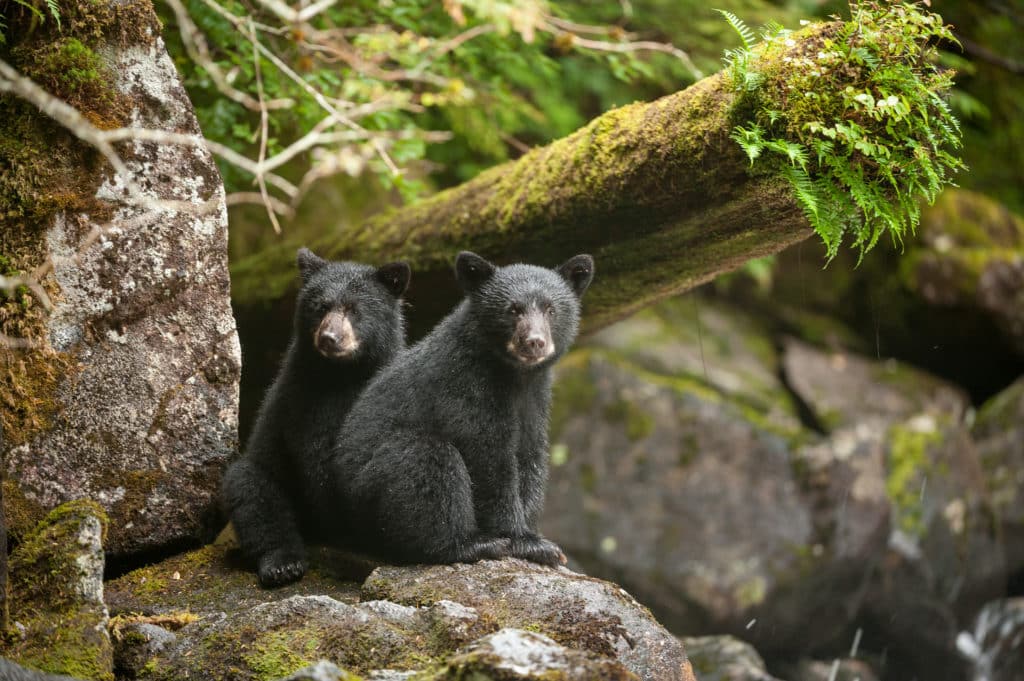
Proposal to extend black bear hunting season on private land in Lower Mainland of B.C.
What this means: The proposed change would add an August 1–31 black bear hunting season on private land in the Lower Mainland (management units 2-2 to 2-19), while leaving existing seasons unchanged.
Pacific Wild’s stance: Prioritize co-existence over killing.
- I oppose the proposed addition of an August 1–31 black bear hunting season on private land in MUs 2-2 to 2-19. The Province frames this as a response to crop depredation and a way to reduce pressure on enforcement resources. However, existing B.C. permit tools and proven prevention measures already provide more targeted and accountable ways to address agricultural conflicts.
- Allowing a black bear hunt during peak foraging increases the risk of higher mortality and mistaken killing of dependent young. The Province’s own guidance notes that it is not unusual for sows to leave cubs for hours while foraging, meaning dependent young may be nearby but not visible at the moment of encounter. In addition, B.C. black bear life-history materials indicate cubs can remain dependent on the sow into late summer. This means that dependent young may still be present but not obviously “in company,” creating foreseeable risk of inadvertent orphaning even where hunters intend to comply.
- Expanding hunting in the densely populated Lower Mainland also raises concerns about cumulative impacts, public safety, and an overreliance on hunting instead of proven, non-lethal conflict prevention.
Feedback due: Feb 13, 2026
Speak up for old growth forests
Oppose old-growth logging before February 22
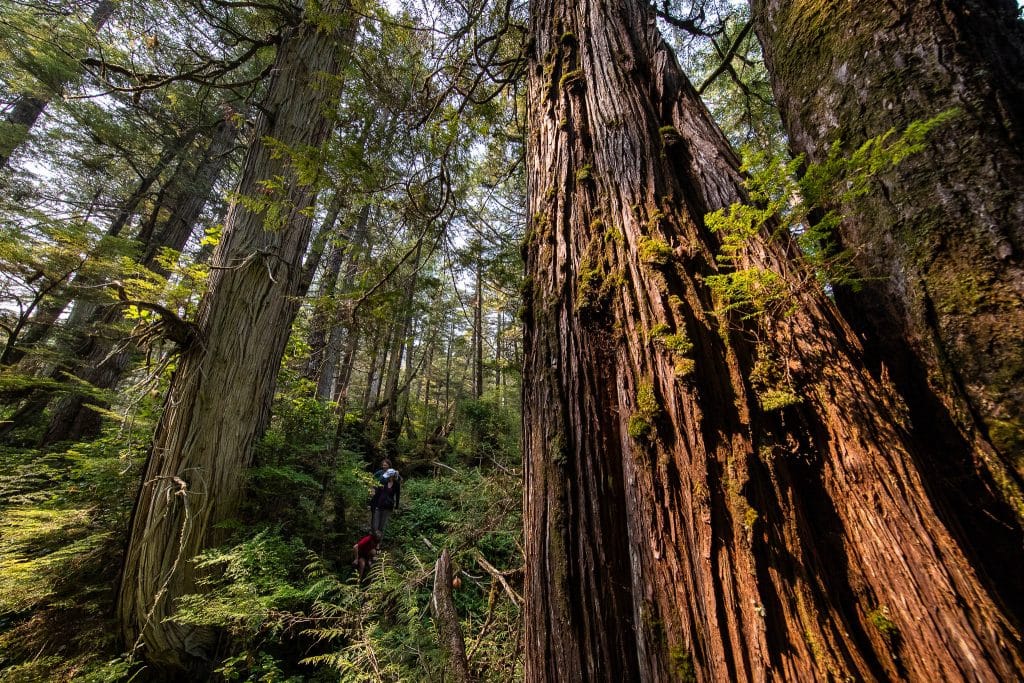
What is proposed: Teal Cedar plans to log a 7-hectare block of ancient yellow cedar forest just 30 metres from the ridgeline of the headwaters of the Fairy Creek watershed, where old-growth logging has been deferred until September 30, 2026 following the request of Pacheedaht First Nation and widespread public opposition. The proposal would also require building roughly half a kilometre of new access road, further fragmenting an already contentious and ecologically sensitive landscape.
Pacific Wild’s stance: This ancient forest deserves protection, not destruction.
Talking points:
- This region supports one of Canada’s largest known populations of Old Growth Specklebelly Lichen, some of the last Marbled Murrelet nesting habitat in the San Juan Valley, and millennia-old trees at the headwaters of Renfrew Creek.
- Cut block 8027 qualifies as ancient forest, defined by the BC government as a forest originating more than 400 years ago, and site conditions suggest this stand may have remained undisturbed for more than a millennium. The presence of massive yellow cedar trees exceeding 2.2 meters in diameter at breast height indicates extremely long ecological continuity. Ancient forests — sometimes referred to by scientists as “antique forests” — are the rarest and most ecologically significant subset of old growth, associated with very low natural disturbance rates and exceptionally high biodiversity.
- The fragmentation of an old growth forest of this size is highly concerning given the importance of large continuous blocks of forest for many old growth dependent species that rely on interior forest conditions. Given the importance of large, intact old-growth landscapes for species that depend on interior forest conditions, the Ministry of Forests should prioritize protecting the entire 1,910-hectare forest complex rather than allowing further fragmentation.
- The area targeted by cut block 8027 holds major cultural, social, and climate value for British Columbians. In 2021, Jim Pojar, PhD, estimated that old growth in and around Fairy Creek holds roughly 600–1,300 tons of carbon per hectare. In addition, the area has substantial tourism potential due to its international profile and is regarded as an important spiritual and symbolic place by many people across British Columbia.
Take action: The Ministry of Forests is accepting public comments on this proposal until February 22nd.
Make your voice heard: tell the Ministry to say NO to the proposal and to instead expand old-growth cut deferrals in this highly at-risk ancient forest ecosystem.
Feedback due: Feb 22, 2026
Instructions for submitting feedback on the proposed cut block:
- Open the public comment webpage:
https://fom.nrs.gov.bc.ca/public/projects?id=2887#details - Scroll to the bottom of the page and click on the button “Submit a Comment”.
- A pop up page should appear with “Terms and Conditions” which explain that any information you provide in your submission will be collected. Click “I agree” if you accept these terms and conditions.
- This should take you to a page with a form asking you to “Enter your contact information (optional)”. This form is completely optional (see note below). When ready, click the button “NEXT” at the bottom right corner.
Note: Providing your contact information allows the Ministry of Forests to follow-up with you if they have questions or need more clarity on your comment. - This should take you to the comment submission form page. Under “Commenting On”, select the cutblock you would like to provide feedback on.
In this case, select “Cut Block 56684 8027”. - In the text box under “Your Comment”, type or paste in your feedback.
Note: Your feedback has a maximum length of 4000 characters. - When ready. click the button “SUBMIT” at the bottom right corner.