Climate Change in the Salish Sea: A Preview of 2095
Climate change is already reshaping marine ecosystems, and the Salish Sea is no exception. A high-resolution model by Khangaonkar et al. (2019) projects future changes under a “business as usual” emissions scenario and found that by 2095, the Salish Sea could be on average 1.5°C warmer across the water column, with sea surface temperature increasing to 1.57°C. Their model also predicts that oxygen levels in the water will drop by 0.77 milligrams per litre, and the ocean will become more acidic, with a decrease in pH of 0.18. These changes are projected to increase algal biomass by 23% and expand areas affected by hypoxia (low levels of dissolved oxygen) from <1% of the Sea to approximately 16% — which may result in a significant habitat loss for sensitive coastal spawners like herring.
It’s not just the amount of algae in the Salish Sea that’s changing — it’s the kind of algae, too. Khangaonkar et al. (2019) project that climate-driven changes in temperature, oxygen, and nutrient dynamics could shift the dominant phytoplankton from large, fast-growing diatoms to smaller, less nutritious dinoflagellates. This shift has serious implications for the entire food web. Diatoms are a critical food source for zooplankton, which in turn are a primary prey for larval herring. When diatom blooms are abundant and well-timed with herring spawning, they support healthy zooplankton populations that fuel larval growth and survival. But if diatoms decline, zooplankton may receive less nourishment or be replaced by smaller, less energy-rich species. This reduces the quantity and quality of food available for herring during their most vulnerable early life stages.
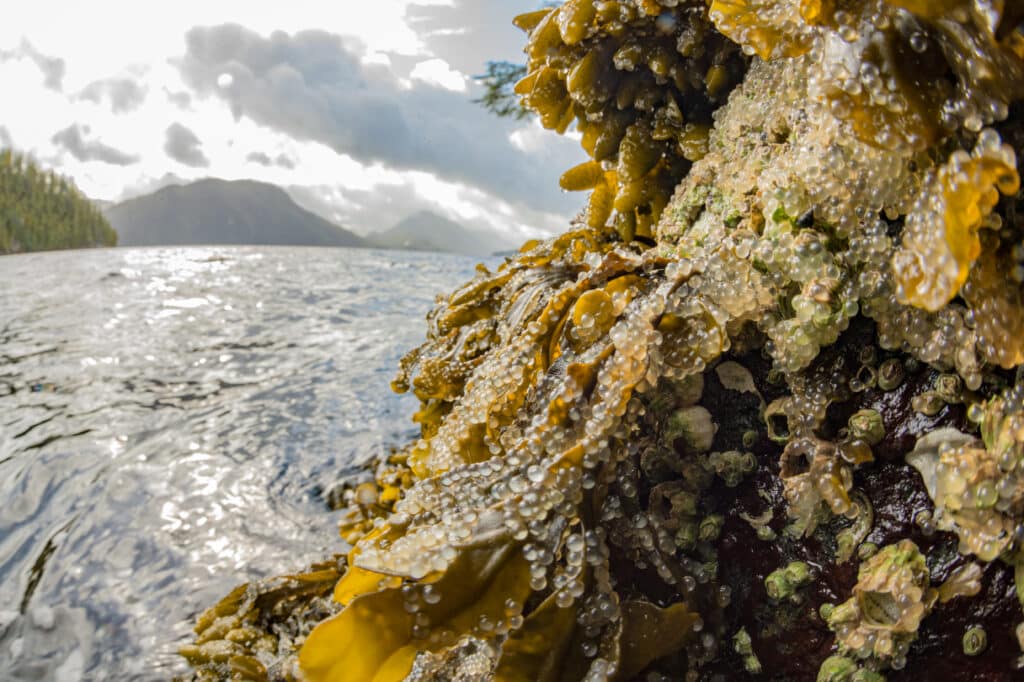
Some species of dinoflagellates can also produce harmful algal blooms (some commonly referred to as “red tides”), introducing toxins that can directly impact herring eggs and larvae.
As a result, even if total phytoplankton biomass increases, the timing and quality of food may no longer align with the nutritional needs of zooplankton and the developmental windows of herring larvae. This kind of mismatch can create a trophic bottleneck — a breakdown at the base of the food web where energy flow to higher trophic levels is disrupted. For herring, that means fewer prey items during a critical developmental period, adding another layer of stress on top of warming waters, acidification, and continued fishing pressure. In a changing ocean, these subtle shifts in plankton communities could quietly undermine the reproductive success of one of the Salish Sea’s most important forage fish.
Real world data in the Salish Sea
While climate models are essential tools that help us forecast long-term ocean and climate trends, including sea surface temperature (SST) increases, real-world data is critically important for validating and grounding those projections. Along British Columbia’s coast, observational records between 1935 and 2014 show a clear and concerning trend: SSTs have risen significantly, with average annual increases ranging from 0.6°C per century at Kains Island (near Winter Harbour) to 1.4°C per century at Entrance Island (near Nanaimo, B.C.).
Seasonal patterns reflect similar warming — for example, Race Rocks (in the Strait of Juan de Fuca) has warmed by 0.7°C per century in winter, while summer temperatures at Entrance Island have increased by an alarming 2.2°C per century with the overall picture being one of consistent regional warming. These observations align with global findings from the Intergovernmental Panel on Climate Change, which reported a global SST rise of 1.1°C per century from 1971 to 2010. The historical data from British Columbia’s coastline shows that this change is not just theoretical. It’s already happening, and it’s painting a similarly concerning picture.
Embryos on Edge: Thermal Sensitivity in Early Life
Laboratory studies by Villalobos et al. (2020) found that increased temperature (from 10°C to 16°C) and higher dissolved carbon dioxide (from 600 to 1200 µatm) had additive effects on developing Pacific herring embryos. Elevated temperatures significantly increased embryo heart rates, mortality, and yolk area, while decreasing larval size and hatching success. Acidification alone had modest impacts, but when combined with warming, the physiological stress was amplified. The message was clear: temperature is the dominant stressor, and when paired with acidification, the risks compound.
Similarly, Murray and Klinger (2022) simulated marine heatwaves, intense temperature spikes that are becoming more frequent, and observed a threefold increase in developmental anomalies in herring embryos. While embryos could survive extreme pCO₂ (a measure of the amount of carbon dioxide dissolved in water, which causes ocean acidification) levels, heatwaves led to rapid yolk depletion, reduced production efficiency, and increased metabolic rates, likely decreasing energy available for growth and later survival.

The Atlantic Cautionary Tale: What Happens Without Precaution
We don’t have to imagine what could go wrong. The collapse of Atlantic herring in the southern Gulf of St. Lawrence, once a robust population, is a vivid example. Despite years of attempted recovery, the population remains depleted. According to Turcotte and McDermid (2024), persistent overfishing and insufficient protection of spawning stock biomass, coupled with warming waters and shifting predator-prey dynamics, have created a scenario where natural recovery is unlikely without significant management reform.
Studies on Atlantic herring eggs and larvae further reinforce the Pacific findings. Leo et al. (2018) demonstrated that warming increased oxygen consumption and altered mitochondrial function, leading to reduced hatching success and smaller larval sizes. Acidification added sub-lethal stress, increasing the incidence of malformations. Sswat et al. (2018) found that larval survival decreased under warming, particularly when food availability was low, a likely scenario as trophic mismatches emerge in a changing ocean.
Pacific Outlook: Early Warning Signs
According to Fisheries and Oceans Canada (DFO), Pacific herring in the Strait of Georgia remain at relatively high biomass levels. However, local populations in the Salish Sea, especially in Puget Sound, have experienced dramatic declines. For example, some Puget Sound stocks are down more than 90% from historical highs. Even where biomass remains high, climate-linked stressors like predation from Pacific hake (which are expected to increase with warming) are projected to suppress herring recovery.
Herring in the North Pacific are also sensitive to oscillating warming and cooling cycles and other decadal ocean patterns, which are expected to become more erratic with climate change. This could destabilize recruitment and create longer periods of low productivity.
A Call for a Precautionary Approach
The science is telling us: don’t wait for collapse. Instead, we must adopt a forward-looking, precautionary approach that allows herring to rebound to levels that support ecosystem function, First Nations access, and sustainable fisheries into the future.
This means:
- Rebuilding to historic biomass levels to buffer against climate variability.
- Incorporating climate projections into stock assessments and rebuilding plans.
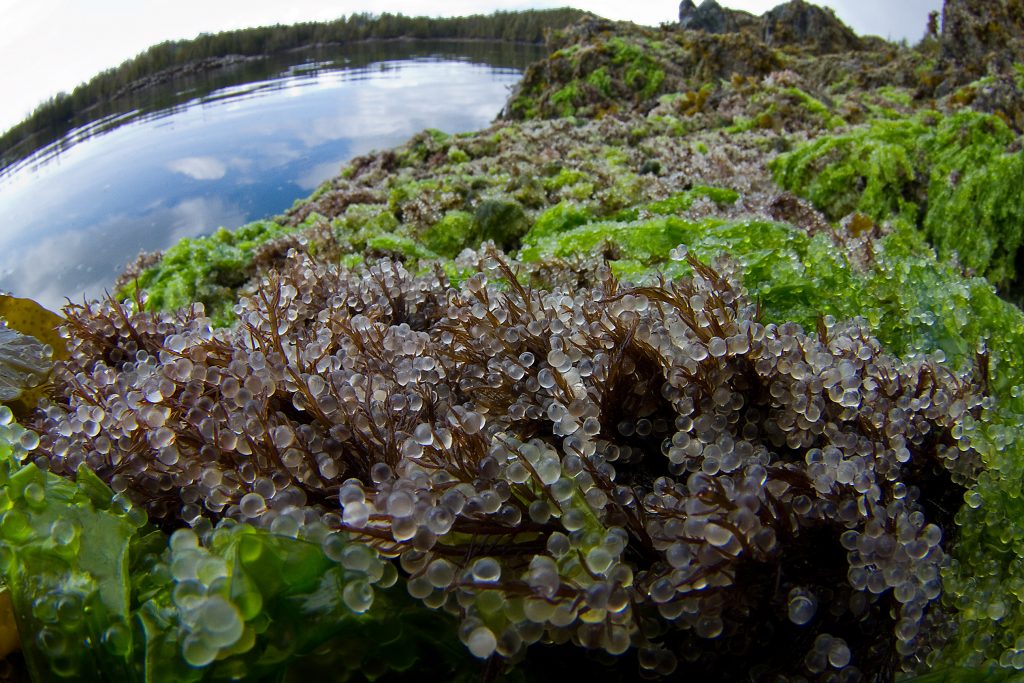
- Protecting critical spawning habitats, especially shallow, vegetated nearshore zones increasingly at risk from warming and pollution.
Supporting Indigenous governance and leadership in herring stewardship, as their knowledge systems are deeply tied to the long-term care of these fish.
Conclusion: Future-Proofing the Forage Base
Pacific herring are the beating heart of the Salish Sea food web. But their eggs may soon be incubating in warming, acidifying, oxygen-starved waters, an environment that is increasingly hostile to survival. We’ve seen how this story ends on the East Coast.
It’s time to flip the script.
While we can’t control global climate trends in the short term, we can control how we respond to their impacts. Enacting precautionary fisheries closures, especially for vulnerable species like Pacific herring, is a powerful, immediate action we can take. It’s an investment in ecological resilience, food web stability, and the future health of coastal communities. In the face of rising uncertainty, precaution is not just responsible, it’s essential. By taking a proactive, precautionary approach, grounded in both Indigenous knowledge and Western science, we can give herring the space and resilience they need to thrive in a changing climate.