When we think of Pacific salmon–iconic, powerful, and culturally vital–we often picture their upstream battles to spawn, their glittering runs through rivers, or their value to coastal communities and ecosystems. But one crucial part of their life story is often overlooked: their deep and critical reliance on Pacific herring (Clupea pallasii).
These small, silvery forage fish, often described as “the currency of the coast,” are more than just a seasonal spectacle—herring are a lifeline for Pacific salmon, providing essential nutrition during the salmon’s most vulnerable life stages. Despite growing scientific consensus, Pacific herring remain undervalued in most salmon recovery plans. It’s time to change that.
Herring: The Unsung Hero of the Marine Food Web
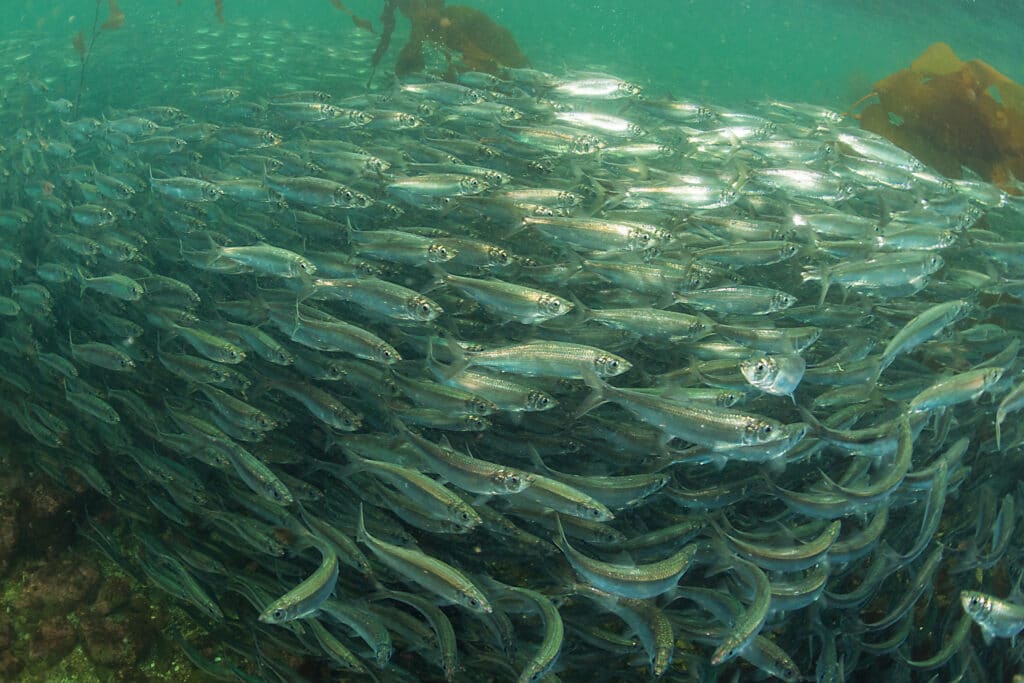
Pacific herring travel in dense, shimmering schools and spawn in nearshore habitats like eelgrass meadows and kelp forests. They are among the most energy-rich prey available in the marine food web, rich in lipids and protein, and accessible to predators from seabirds to whales to salmon.

For Chinook and coho salmon in particular, herring are an essential food source during early marine life stages. After leaving freshwater, juvenile salmon face the open ocean for the first time, and their survival largely depends on how fast they can grow. Studies indicate that forage fish like herring and sand lance make up a significant portion of juvenile salmon diets in key regions such as the Strait of Georgia, Puget Sound, and the outer continental shelf.
In fact, herring are the most important prey item by mass in a detailed study of juvenile Chinook salmon diets in the Southern Gulf Islands. While only 8.4% of juvenile Chinook stomachs contained herring, those fish had greater stomach fullness, faster growth, and larger body sizes than those Chinook feeding on invertebrates alone. That’s because each individual herring meal provides much more energy than tiny zooplankton or larval fish.

Why Early Marine Growth Matters
The first few months after entering the ocean are make-or-break for juvenile salmon. The critical size hypothesis suggests that individuals who don’t grow quickly enough are more likely to die from predation, starvation, or insufficient energy reserves to survive the winter.
Recent studies have supported this link between early marine growth and long-term survival. Juvenile Chinook salmon that successfully transition to piscivory—shifting their diet from zooplankton to small fish like herring—are larger, faster-growing, and more likely to survive.
This dietary transition is especially important for Chinook, whose longer ocean residence and larger adult size require a rich and consistent energy supply throughout life. Herring, being energy-dense, provide the high-calorie nourishment young Chinook need to sustain rapid growth, build fat reserves, and improve their chances of surviving their first critical months at sea.
The critical size hypothesis for juvenile salmon is the idea that survival depends on their size and strength. If they haven’t grown big enough by the end of their first summer in the ocean, they won’t make it through the winter.
Phenological Diversity: Timing Matters
For salmon, it’s not just about how many herring are available, it’s also about when they’re available. Pacific herring populations across the Salish Sea spawn at different times of year, historically from January to as late as June. This phenological diversity creates a “resource wave“, a staggered sequence of prey availability that extends foraging opportunities for mobile predators like salmon.
Juvenile salmon are gape-limited, meaning they can only eat prey below a certain size. May-spawning herring, which produce smaller, younger-of-year individuals during summer and fall, are particularly important for juvenile Chinook salmon.
Genetic analysis of herring found in the stomachs of juvenile and adult Chinook salmon shows that juveniles primarily consume early spawners, while adults feed on herring from a broader range of spawning groups. This underscores the importance of maintaining spawning population diversity among herring, not just abundance, because it directly affects salmon feeding success across seasons and life stages.

When Herring Go, So Do Salmon
The bond between herring and salmon runs deeper than ecology—it’s also a story of shared fate in conservation.
Many Chinook salmon populations in southern B.C. and the broader Pacific Northwest are now threatened or endangered. While recovery efforts have focused heavily on freshwater habitat restoration, most salmon mortality occurs at sea, especially during the early marine stage. And that’s exactly when herring matters most.
When herring populations decline, salmon suffer too. In the Strait of Georgia, for example, a simultaneous collapse of both juvenile salmon and herring production in 2007 preceded a historic crash of Fraser River sockeye returns in 2009.
Across British Columbia, herring populations have dwindled dramatically, with spawning events in places like the Strait of Georgia, now fewer, smaller, and over shorter time periods. In some regions, herring numbers have plummeted to an estimated 1% of their historic abundance, while in others, they have disappeared entirely.
This loss narrows the feeding window for salmon, while signaling much wider ecological distress. Overfishing, habitat degradation, pollution, and climate-driven shifts in ocean conditions have all taken a toll on these small but mighty fish.
Protecting herring, then, is not only about restoring a forage fish—it’s about giving salmon, and the ecosystems and cultures that depend on them, a better chance to thrive.
Industrial Fisheries and the Problem of Waste
Even more troubling is the ongoing waste caused by industrial fishing. In the groundfish trawl fishery, herring are frequently caught as bycatch and then discarded– dumped back into the ocean, dead or dying– because they are a prohibited species that cannot be brought back to the dock. This needless loss weakens marine food webs and robs salmon of a key prey source essential to their survival.
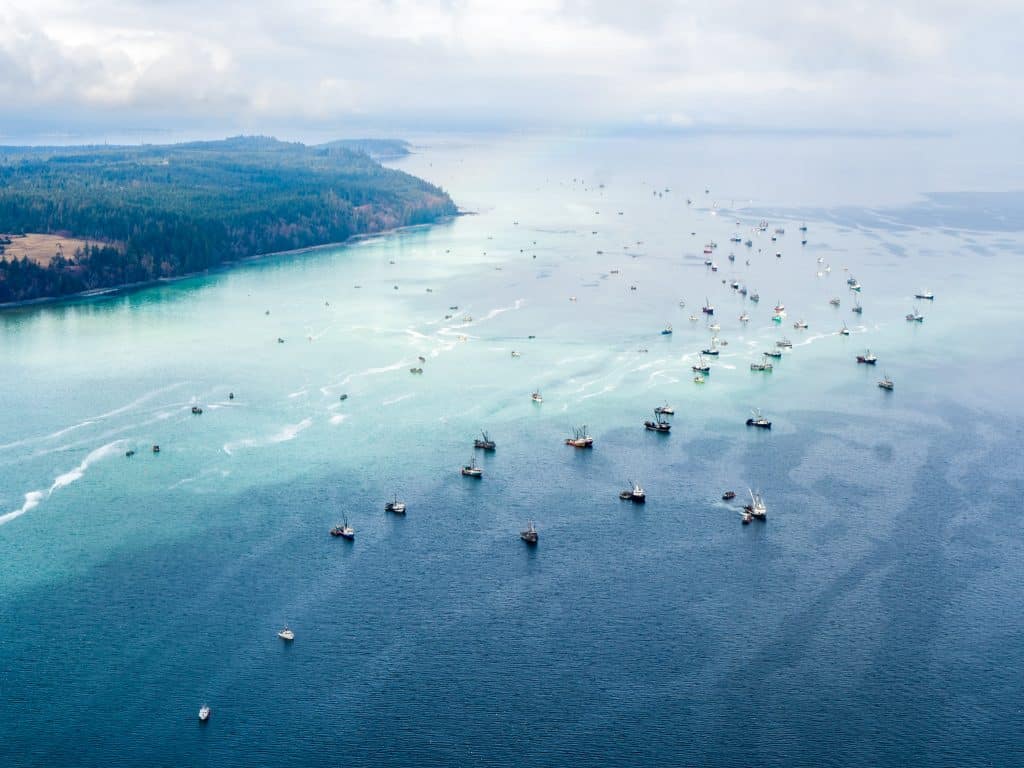
Adding insult to injury, the commercial sac roe fishery has long targeted herring at the peak of their spawning cycle, removing entire schools for their eggs, further removing food availability for salmon and other predators.
Indigenous Knowledge: The Original Stewards
Long before Western science, First Nations along the Pacific coast understood that herring sustain the entire marine food web. These Nations managed herring through systems rooted in reciprocity, respect, and long-term responsibility.
In the words of the Kitasoo/Xai’xais First Nation:
"Herring also sustain us indirectly; they are prey to other species in our traditional diet, such as salmon, rockfish, halibut and lingcod. Beyond providing physical sustenance, herring are inherent to our cultural identity; they play critical roles in the stories and spirituality of our people"
Kitasoo/Xai’xais, 2022, p. 4
Today, many First Nation communities are leading the way in restoring both salmon and herring populations through Indigenous law, marine planning, and community-led stewardship.
Haida Gwaii ʹíináang | iinang Pacific Herring: An Ecosystem Overview and Ecosystem-based Rebuilding Plan
The Haida Gwaii Pacific herring rebuilding plan stands as a landmark of Indigenous-led, ecosystem-based fisheries management. Co-developed by the Council of the Haida Nation, Fisheries and Oceans Canada (DFO), and Parks Canada, it combines Haida traditional knowledge with Western science to define what a rebuilt herring ecosystem looks like–ecologically, culturally, and socially. Taking a cautious, long-term approach, the plan prioritizes ecosystem recovery and supports sustainable, low-impact fisheries such as the spawn-on-kelp fishery.
Gitdisdzu Lugyeks (Kitasu Bay) Marine Protected Area
Established by the Kitasoo Xai’xais Nation in 2022, the Gitdisdzu Lugyeks (Kitasu Bay) Marine Protected Area safeguards one of the last abundant herring spawning grounds on B.C.’s central coast. Its management plan blends traditional Indigenous knowledge with modern science, emphasizing sustainable harvesting and ecosystem stewardship. This initiative demonstrates how Indigenous governance can protect biodiversity while ensuring that herring populations and the communities that depend on them, remain resilient long into the future.
Nuu-chah-nulth Leadership on West Coast Herring Recovery
In November 2024, Nuu-chah-nulth leaders reaffirmed their commitment to conservation by maintaining a commercial herring fishery closure on the west coast of Vancouver Island for 2025, despite signs of herring recovery. Their decision reflects a priority to long-term ecological health and cultural continuity over short-term economic gain. For the first time in several years, however, a commercial spawn-on-kelp fishery–led by the Ha’oom Fisheries Society–aims to harvest herring roe (k̓ʷaqmis) attached to kelp, creating a sustainable, low-impact alternative that is economically viable and aligns with Indigenous stewardship principles, ensuring that herring populations remain robust for future generations.
Slhawt’/Herring Spawn Surveys in Átl’ḵa7tsem (Howe Sound)
In Átl’ḵa7tsem (Howe Sound), the Squamish Nation and the Marine Stewardship Initiative (MSI) are leading Slhawt’/Herring spawn surveys, a community-driven initiative that engages volunteers in monitoring and documenting Pacific herring (Slhawt’) spawning events along the Squamish Estuary from February to April. By collecting data on spawn distribution, abundance, and timing, the program builds a long-term dataset that informs regional decision-making and strengthens the recovery of herring populations, which are vital to both the local ecosystem and cultural practices.

What Needs to Happen Next
Both science and traditional knowledge are clear: protecting herring is essential to saving salmon.
Here’s what we need to do:
- Integrate herring into all salmon recovery plans, especially for Chinook populations.
- Protect and restore herring spawning habitats, including eelgrass beds and kelp forests.
- End destructive and wasteful industrial practices, such as herring bycatch in trawl fisheries and the commercial sac roe fishery.
- Support Indigenous-led conservation efforts that prioritize ecosystem health and food security for all.
Little Fish, Big Consequences
Pacific herring may be small, but they are among the most important species on the coast and we scoop them out of the ocean by the tonne each year. Salmon need herring. So do whales. So do seabirds. And so do we.
When herring thrive, so do salmon. And when they disappear, so do the chances of salmon recovery.
Let’s stop treating herring as expendable and recognize for what they truly are: a foundational species holding up the entire coastal ecosystem.
Little fish. Big consequences. #ProtectPacificHerring.