In June 2025, the 3rd United Nations (UN) Ocean Conference in Nice, France, brought together UN countries, governments, and civil society groups (like scientists, NGOs, and businesses) to accelerate global action for ocean conservation. From the opening speeches to final declarations, the messaging was clear: there is no ocean conservation without protections for the deep sea.
The deep sea starts at a depth where sunlight no longer penetrates, around 200 metres. It comprises 90% of the ocean’s volume and spans beneath 65% of our planet’s surface. While previously thought to be a barren and unchanging landscape, the deep seafloor is now recognized as one of the most biodiverse regions on Earth, comparable to a tropical rainforest. Composed of a tapestry of interconnected habitats, deep sea ecosystems perform vital functions supporting life on our planet, like nutrient cycling (where nutrients are broken down, reused, and moved through the ecosystem to keep life going), carbon storage, and by providing biological and mineral resources. Without question, the services provided by the deep sea are foundational to planetary health.
As new technology unlocks greater frontiers for deep sea exploration, research in these remote environments is expanding rapidly, and with nearly expedition new characteristics and processes are revealed. However, these discoveries are happening alongside growing interest in exploiting deep sea resources, meaning time is running out to fully understand and protect these complex ecosystems.
While a deeper understanding of deep sea ecosystems helps inform strong, effective ecosystem-based management strategies, we already have enough knowledge to act. Here’s a snapshot of what we know, and what’s at stake.

Ecology of the Deep Sea
In transitioning from surface waters to deep ocean ecosystems, light fades rapidly, temperature quickly drops, and the weight of the water accumulates to a crushing force. In these extreme conditions, seafloor ecosystems have adapted to flourish as a mosaic of interesting habitats. Many ecosystem types exist in unique ways along plains, underwater mountains, volcanic vents, and canyons. Here are a few that are being explored and are, likewise, threatened by industrial interests:
- Abyssal Plains are expansive ecosystems with biodiversity flourishing on a unique array of mineral deposits, like polymetallic nodules. Polymetallic nodules are slow growing (only a few millimetres per million years) and cover areas beyond the continental shelf, where environmental conditions remain very stable. These ecosystems host thousands of species, including a diversity of arthropods, echinoderms, worms, and sponges, with the vast majority of species and functions remain undiscovered and undescribed.
- Seamounts (underwater mountains) are complex and diverse, with novel roles continuously unraveling with each one explored. Because these ecosystems are “hot spots for rarity”, they cannot be easily generalised, however, most generate conditions for nutrient-rich and productive waters providing a foundation for healthy food webs. Seamounts carry unique “magnetic signatures” through metal-rich crusts, which aids migratory species, like whales, sharks, fishes, as a reference point for navigation and further attracts certain species by providing suitable refuge for breeding, feeding, and as nursery habitats. The structure of seamounts can also shape ocean currents and influence tides.
- Hydrothermal vent ecosystems are thought to be the origin of life on Earth. These vibrant communities are founded on specialised bacteria that oxidise chemicals leaking from volcanic fissures on the seafloor, supporting complex food webs with animals like tube worms, vent crabs, and shrimp that have adapted to thrive in high temperatures. As one of few ecosystem types surrounding seafloor fluid emissions, hydrothermal vents play an important role in ocean chemistry and climate regulation, and they also form significant metal deposits such as polymetallic sulfides.
Cycles of the Deep Sea
Beyond the incredible abundance of life these ecosystems support, the deep sea is essential for regulating our planet’s climate. But how does it do this?
Some ecosystem services provided by the deep sea include:
Carbon Sequesteration
Algae blooms at the ocean’s surface capture CO₂, and as these algae die and sink, they transport that carbon down into the deep ocean over time. This process, known as a biological pump, locks carbon away for decades to centuries and stabilizes atmospheric CO2 by hundreds of parts per million.
Oxygen Production
In abyssal plains, polymetallic nodules produce oxygen without photosynthesis by emitting a weak electrical current that reacts with sea water to release oxygen, called “dark oxygen”. This discovery was only published last year, by a scientist assessing marine biodiversity in an area that’s earmarked for mining polymetallic nodules. This discovery holds major implications for how life can exist on our planet, as well as other planets.
Microbes Curb Methane and Fuel Ocean Life
Microbial ecosystems in cold seeps and hydrothermal vents perform anaerobic oxidation of methane. This process consumes methane before it reaches our atmosphere, thereby curbing greenhouse gas effects. Other organisms, like microbes and sponges, recycle nutrients (such as nitrogen and phosphorus) in cycles that ensure nutrients flow back to the surface, feeding the process that fuels productivity, biodiversity, and more carbon capture all over again.
Trouble in the Deep Sea
Many of the aspects that make the deep sea special, like mineral reserves and biodiversity, are part of the reasons that it is under threat today. The pursuit of mining operations, in combination with overfishing and climate change, is already driving habitat degradation and biodiversity loss.
Today, deep sea mining is only planned within a few national jurisdictions and some exploration contracts are in place within international waters. The deep sea mining industry seeks valuable mineral deposits (like copper, cobalt, nickel, and lithium) for developments in digitisation, decarbonisation, and infrastructure. These critical minerals are used in everything, from wind turbines, to cell phones, to steel, to electric vehicles, to medical technologies, and the demand is estimated to double by 2040. Although in-demand resource minerals can be found on land, the deep sea offers a pathway that could – according to industry – prevent terrestrial environmental hazards and offer the space to scale up mining operations quickly.
Additionally, it is important to recognise that the deep sea itself already plays a vital role in decarbonisation without the exploitation of minerals. Disturbing these ecosystems through mining is disruptive to cycles like carbon sequestration, thus, all assessments for deep sea mining will need to weigh the benefits of mineral extraction against the cost of compromising these complex and valuable ecological services.
Retrieving mineral deposits differs depending on the ecosystem. For polymetallic nodule ecosystems, where most mining exploration is focused, a vacuum-like suction device removes the top layer of sediment. High powered jets create a stir to dislodge nodules, collected materials are piped to the surface, and waste (sediment, organic materials) is pumped back into the water column, releasing carbon stored in the deep sea in the process.
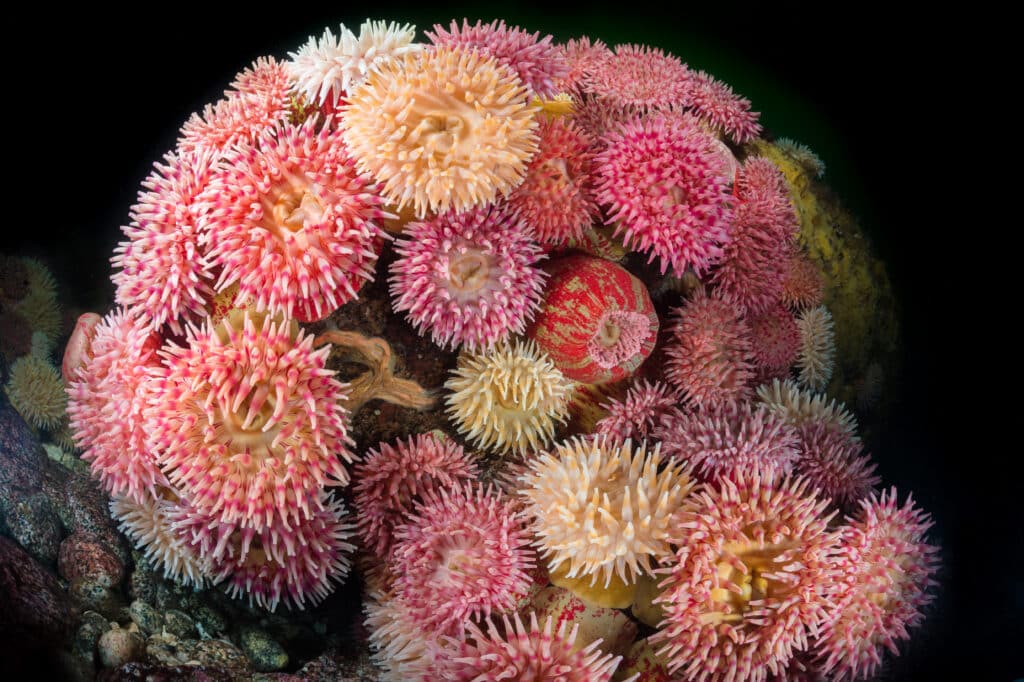
Mining the deep sea permanently destroys hard substrate relied on by many species for anchorage,like sponges and sea anemones, while crushing, dispersing, and burying existing fauna. This can alter communities for decades or millennia.
Sediment plumes may also introduce metals at toxic concentrations to nearby ecosystems or migratory fish, like salmon. Even smaller sediment plumes interfere with an animal’s ability to breathe, feed through filtration, or communicate through bioluminescence. Furthermore, removing the top sediment layer is harmful to sea life by changing chemical conditions, such as oxygen concentrations, pH, temperature, and toxicity, all while contributing to noise and light pollution.
Finally, seabed disturbances release stored carbon dioxide into the atmosphere from organic matter that has decayed and accumulated over time. Although disruptions to carbon sequestration for the deep sea mining industry have not been adequately measured yet, seabed alterations from the bottom trawling industry, comparably, release emissions equivalent to those from the aviation industry.
In addition to interfering with global climate regulation, the deep sea experiences change at a local level. Some deep sea regions show sensitivities to climate change at rates quicker than most ecosystems on land. For instance, one study observed 100 years of climate change on a seamount over the course of six years. It is the fragility of these remote places, up against momentum of exploitation, that scientists raise as a major cause for concern.
Management of the Deep Sea
In British Columbia, both industrial bottom trawling and proposed deep sea mining pose complex and long-lasting threats to the deep sea. Decades of bottom trawling have degraded continental slope habitats, destroying thousands of kilometres of biodiversity with scars remaining from decades past, some over 20 cm deep. Bottom trawling continues to be permitted in some marine protected areas (MPA) and there are spillover effects from trawl activity near MPA boundaries.
Note: While the term “spillover effect” is often used positively to describe the movement of marine life from protected areas to adjacent regions, in this context, it refers to the negative physical and ecological impacts extending beyond MPA borders due to nearby trawling.
Bottom trawling is actively occurring in Canadian waters and, while deep sea mining has not yet begun on Canadian coastlines, interest is growing and Canadian companies are pursuing exploration where they are permitted outside of Canada. The parallels between both activities, related to physical disturbances and disruptions to biogeochemical cycling, are not to be overlooked in future management efforts, as the combined impacts could have synergistic effects towards degrading ecosystem resilience and increasing carbon emissions.
Since 2023, deep sea mining exploration in Canada has been held at bay by national moratorium, defined as a temporary pause on exploration until more is known about these ecosystems and legal framework can be established. This ban could be removed in the future, however, there are already protections for 90% of its known seamounts and all known hydrothermal vents in Canada. There is also a building momentum towards the ratification of the High Seas Treaty – a global agreement poised to address critical regulatory gaps in protecting areas beyond national jurisdiction.
Note: ⅔ of the ocean falls beyond national jurisdiction and belongs to no country in particular.
Currently, there exists no broad management structures for this part of the ocean, leaving the high seas governed only by a patchwork of various fisheries agreements and protected areas.
The High Seas Treaty
The High Seas Treaty will enable legally binding protections in international waters, where most deep sea mining is being explored. The treaty will unlock environmental impact assessments, equitable benefits sharing, and scientific oversights. Specifics on how this could be managed and implemented remains to be discussed at upcoming negotiations (once ratification is complete), but coordinated and cross-boarder protections against illegal fisheries and exploitation are gaps that the High Seas Treaty will hopefully address.
This is where the value of the UN Ocean Conference comes in. Currently, Life Below Water remains the least funded and most under-represented sustainable development goal of the United Nations. In the context of the Kunming-Montreal Biodiversity Framework, where countries pledged to protect 30% of biodiversity by 2030, the ocean is only mentioned a handful of times, despite hosting the majority of life on earth.
No protections currently exist for marine life outside of national boundaries, where most deep sea ecosystems flourish, and even within federal boundaries, there are gaps related to the size, position, and effectiveness of MPAs.
To address these gaps and establish more connectivity in ocean management, the UN Ocean Conference generated momentum towards the High Seas Treaty, financial commitments, and expansions on MPAs. During the conference, 19 countries ratified the High Seas treaty, bringing the total number of countries that have ratified it to 50, while 60 are needed for it to be brought to force. While still underwhelming, new commitments of 8.7 billion euros were pledged for the ocean by 2030, and a number of marine protected areas were announced. At long last, a wave of support for deep sea protections echoed throughout the event, with calls to ban deep sea mining and increase monitoring, research, and policy for the deep sea.

The bottom line? Deep sea protection cannot happen in the presence of the invasive and significant seabed disturbances created by the trawl and deep sea mining industry. While some Marine Protected Areas (MPAs) exist to protect biodiversity of the deep sea, there are many that fall short in scope and enforcement. First, many MPAs continue to allow bottom trawling within or nearby MPA boundaries, which leads to disturbance and destruction of these fragile ecosystems. Secondly, the fragmented and inconsistent design of current MPAs fails to reflect the nuance of ecosystem processes and connectivity across these vast and interdependent deep sea environments.
This is where the evolution of the High Seas Treaty offers critical potential. As a legally binding instruction, the agreement introduces mechanisms for marine protected areas and environmental assessments. If properly implemented, the treaty could strengthen our ability to manage the cumulative threats of deep sea mining, overfishing, pollution, and climate change.
Moving beyond fragmented management structures, the path forward means creating large, ecosystem-based networks of MPAs, recognizing deep sea health as essential to overall ocean health, and ocean health as foundational to planetary health. While Canada took an important step by signing the High Seas Treaty on March 4, 2024, it has not yet ratified the agreement. Full commitment will require further domestic legislative action. The treaty represents a critical opportunity to shift toward cohesive global ocean governance, one that aligns with protecting marine biodiversity beyond national jurisdictions.
Help strengthen the call for ocean protection—send a letter to Prime Minister Mark Carney and Fisheries Minister Joanne Thompson urging Canada to ratify the High Seas Treaty.
To learn more, please read this open letter – co-signed by Pacific Wild – to the Canadian government from more than 30 conservation groups calling on Canada to be a leader in protecting the High Seas.